
In recent years, we have adopted a new policy when it comes to visiting big art galleries. Rather than attempting to see every exhibit on display and paying each one no more than a cursory glance, instead we pick out just one item that we really want to see, and then we devote a proper amount of time to really look at it.
At the Kunsthistorisches Museum in Vienna, the item we had decided to focus on was Benvenuto Cellini’s Salt Cellar. But events didn’t pan out that way.
Our selection of the Cellini masterpiece had more than an element of confirmation bias about it. A photograph of the famous gold statue appeared on the front cover of the Penguin Classics edition of Cellini’s autobiography, which we read in the early ‘90s. That tenuous personal link alone instilled the object with something of the status of an icon for us.
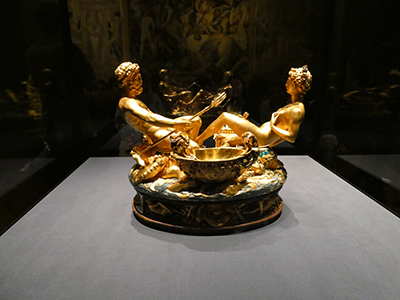
And it was clear that it held a similarly exalted position for the Kunsthistorisches Museum: it featured heavily in their publicity material; was indicated as a highlight in their guide and map; was clearly signposted within the gallery itself. True to our new gallery principles, we hurried towards our intended goal, ignoring other works of art in our single-minded quest.
Except…
What was that marble bust of a young woman that we glimpsed as we were so cavalierly rushing past? We were momentarily stopped in our tracks. Surely this deserves more than a backward glance?
But, no, we were on a mission. It was Cellini not bust.
And there it was. Scarcely another room on. The Cellini Salt Cellar. Grandly displayed, so that it was possible to view it from 360°; big comfy sofa close by, for anyone who wanted to really kick back and settle down to a prolonged contemplation.
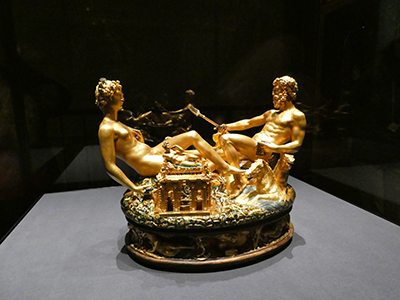
And it is an extraordinary piece of art. Incomprehensibly crafted; breathtakingly exquisite; but, also, rather hideous. Personally, we wouldn’t have chosen it to stand on the middle of our own dining table amongst the other condiments. And, all the time that we were circling it, admiring every minutest detail, at the back of our minds recurred that fleeting image of the ethereal marble bust, which we had cantered past with unseemly haste so ungallantly.
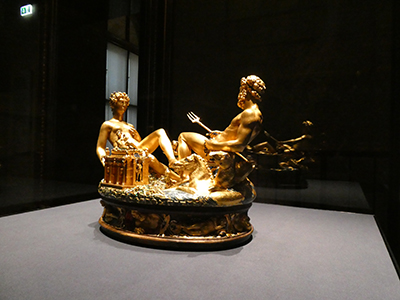
Genius duly acknowledged, nevertheless there is only so much time that can be spent in reverence and our time of genuflection for Cellini was up. Unspoken, we returned to the marble bust. The label attributed it to Francesco Laurana, although much of the other biographical detail was enigmatically vague. It might have been created in Milan. It might have been sculptured in 1490. It was called Portrait of Laura, although even that was followed by a question mark. It went on to say that: ‘Francesco Laurana executed a number of female busts whose rigid stylization continues to puzzle and attract. The bust in Vienna is the only one that retains the original polychromy. The striking similarity between the bust and a surviving depiction of Laura––celebrated by the famous scholar and poet Petrarch––suggests that this may be her likeness.’

‘Puzzle and attract’. They had been the very feelings we had experienced upon first glimpsing the statue. And they were reactions, which did not lessen the more we studied it. Of course, Petrarch’s emotions had run deeper still. He devoted over three hundred love poems to Laura, a mysterious woman that he met in the church of Sainte-Claire d’Avignon in 1327. Speculated to be Laura de Noves, the wife of Count Hugues de Sade, Petrarch makes no definitive disclosure regarding her identity.
However, it needs no concrete bibliographical information to appreciate the beauty of the marble bust. There is something sympathetically understated about the entire work, which shows itself in stark contrast to the Cellini Salt Cellar. The downward cast of Laura’s eyes; the subdued tones; the simple sculptured lines. It has a purity, which is greatly appealing.
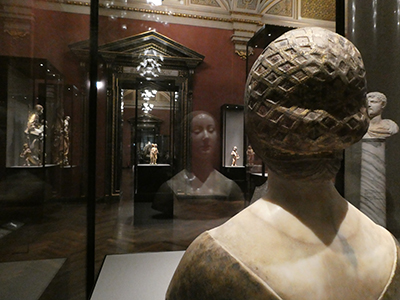
We enjoyed the way that even when viewing the rear of the bust, the glass case reflected Laura’s face, such that she remained a constant presence.
Since our own visit to the Kunsthistorisches Museum, we have been pleased to see that Laura has been given her own special exhibition: In Love with Laura at the Kunstkammer. A very fitting recognition of a beautiful work of art.
© Os Bros
Os Bros are a little bit in love with Laura.
 Mudskipper Press
[…] niche elements at the exclusion of everything else. This tactic has worked well for me at the Kunsthistorisches Museum in Vienna and at the Casa-Museo de Antonio Machado in Segovia if, in that later case, rather […]
LikeLike