
The India Club is closing. After 70 years. Its last day of operation will be 17 September 2023. The Hotel Strand Continental, which houses the club, is being modernised, and the iconic venue has no place in the new plans.

I feel sad at the news; sad that an historic London meeting-place is closing. But might my emotion be slightly phoney? After all, during all its long tenure, I have never visited the India Club once; am only inspired to visit now because of the very fact of its imminent closure. A deadline tends to focus the mind. I cannot claim to be a habitué of the establishment; more, an opportunist culture-vulture, only sweeping in at the last moment, to pick over the Jalfrezi chicken bones.

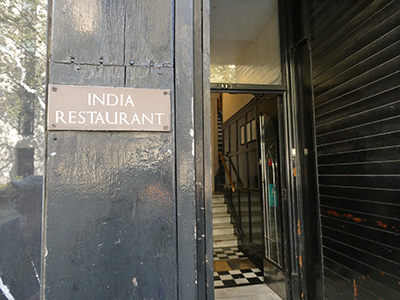
Regardless of my dubious credentials, I am welcomed in the same fashion as every other diner through their door. I walk up to the second floor, where my name is added to a waiting list, and then advised to go back down one floor to the bar, and wait to be called.
“How long?” I ask, guardedly.
The man looks as his list, appraisingly:
“About 40 minutes.”

In some sort of strange synchronicity, London is experiencing an early-September Indian-summer heatwave, and I order a cooling bottle of Bombay Bicycle IPA, and sit by an open door at the rear of the bar, where there is a hint of breeze cutting through the humid atmosphere, and a gloriously unappreciated view across the fire-escapes and rooftops to Somerset House.
It is almost 40 minutes to the dot when I receive my summons to dine.
The first thing that strikes me about the India Club is the noise. The sound of chatter is deafening. I don’t know about it being a renowned debating venue; those great thinkers must have had far better hearing that I have even to hold the most rudimentary conversation.
I am given a menu. It is lunchtime; I only want something light and simple. I order a vegetable curry, pilau rice, and a glass of water. Last of the big spenders.
“Mango chutney?” I ask, hopefully.
The waiter shrugs:
“Finished.”
While I wait for my food, it is an opportunity to observe the room and its clientele. It is a simple, rectangular space: small serving counter; yellow ochre walls; ornamental, silver, hanging lanterns; and nice lattice windows with a view over the treetops in the Strand. A modest smattering of Indian-themed photographs and paintings bedeck the walls.
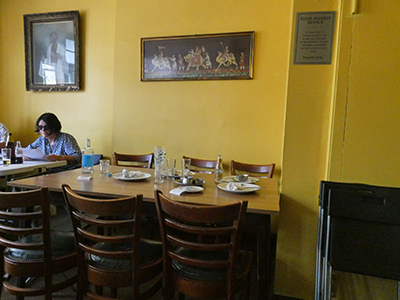
My fellow-diners appear rather more like colonial administrators than original denizens of the sub-continent. There are one or two obvious students, but the average age of the clientele does not make my grey hairs feel out-of-place. There are one or two faces that I feel I should recognise. Is that the actress Susie Blake? Or maybe just a lookie-likie. And the man with the long white hair in the corner; somehow, I know him from the TV. A philosopher, or an historian, or a writer, or a cultural commentator. I just can’t put a name to the face. I’ve got A. C. Grayling in my head, but it is not him. And now I’ve got A. C. Grayling stuck there, I can’t think of anyone else. I know this non-recognition is going to bug me.
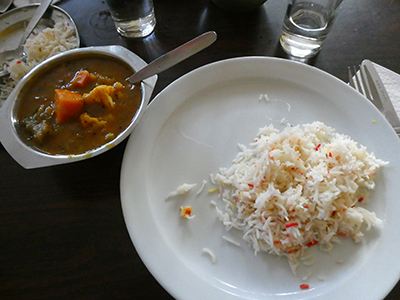
When it arrives, my curry is as simple as I had ordered, and slightly more simple than I had hoped. It makes a perfectly decent lunch, but it is not a meal to linger over. I find myself retracing my steps back down the stairs from the second floor before I know it, my head more replete with questions regarding the identity of the white-haired man than my stomach is with curry.
Ahead of me, an elderly woman is taking the flight of stairs down––very––slowly, and I fall into dignified step behind her.
“I used to come here in the old days,” she tells me. “I wanted to see it for one last time.”
And, suddenly I feel rather sad again.
© Simon Turner-Tree

Simon Turner-Tree is still trying to recall the name of the white-haired man.
Simon Turner-Tree is the author of This Pedestrian Life and Watching Life Pass Me By.
 Mudskipper Press