
Ruins were a recurring motif of Romanticism; remembered in the poems of Byron and Shelley; celebrated in the paintings of Turner and Friedrich. If any of these artists were requiring inspiration for their works today, I think they would find it in the Maunsell Forts in the Thames Estuary.
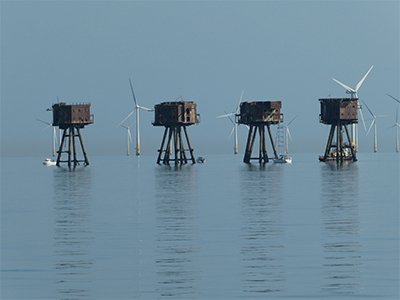
The Maunsell Forts––named after their designer, Guy Maunsell––were built during the Second World War to act as defensive fortifications for London against approaches by either sea or air along the River Thames.
After the War, the Forts fell into disrepair and, despite occasional occupations––notably as a pirate radio station––their structures have steadily become more ruinous, constantly battered by the twin attacks of sea and wind.
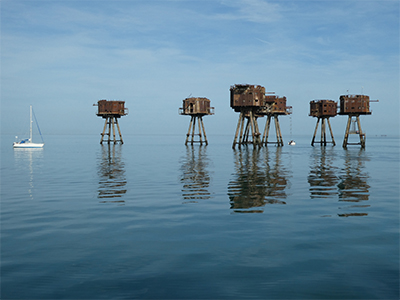
Often, I had admired the strange structures from the distant shoreline of Whitstable, where they appear as tantalisingly hazy shapes on the horizon; twice, I had attempted to get out closer to them by yacht, both times being thwarted by bad weather. But then, all together, came the combination of a bright, calm day in early October, and a scheduled boat trip from the end of Southend Pier with the proposed destination: the Maunsell Forts.
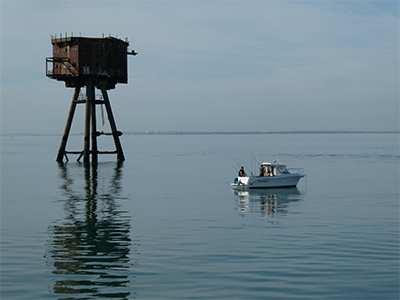
The boat proposed to visit two sites of the Forts: the Red Sands Forts and the Shivering Sands Forts. When they had been first built, each construction would have consisted of seven separate Forts, joined by high-level metal walk-ways. Nowadays, one of the Shivering Sands Forts has collapsed altogether––the result of a ship colliding into it in 1963––and the metal walk-ways have almost all entirely disappeared.

For some people, the Forts must simply appear as a rusty collection of old junk marooned out at sea but, for me, they have an aesthetic beauty linked, in part, to the Romantic ideas of ruins from the past but, also, to a futuristic vision of a voyage into the outer space of imagination, every bit as magical as a trip on Jeff Bezos’s Blue Horizon space shuttle, but without having to have William Shatner for company.

The Maunsell Forts look like a Wellsian-envisaged invasion force of alien Tripod creatures, only delayed in their conquest of Earth by becoming trapped in the notorious shifting sandbanks between the Kent and Essex coasts. It is in their decrepit helplessness lies their beauty. They could be the last survivors of a dystopian world; relicts of a steampunk-imagined creation.
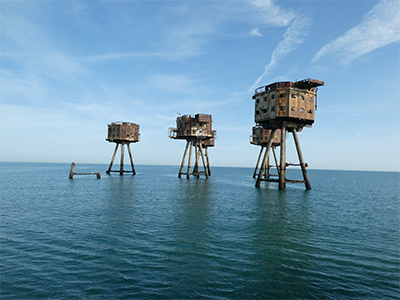
Slowly, we circle each set of Forts in its turn, the sun variously casting them as stark silhouettes or illuminating them in bright relief.

It is now eighty years since the Forts were first constructed. Currently, no authority wishes to lay claim to them––the costs of either renovation or destruction too high for anyone to want them for their own. And, so, as I say farewell to the Forts with my boat turning to head back to shore, I leave them to their gradual picturesque ruin, unwanted but not unloved, property of no one but the sea and air.
© Bradley Dunbar

Bradley Dunbar waves a fond farewell to the Maunsell Forts.
The Maunsell Forts make an appearance in Garnet Beck’s novel Death on the Oyster Bay Trail.
 Mudskipper Press