
Saturday or Sunday afternoon, sometimes Saturday and Sunday afternoon, will often find me sat in front of my computer screen, following the BBC live text updates of the Premier League football matches happening that day.
As an activity, I find it both calming and tense: calming, in the long periods of quiet introspection between messages appearing on the screen; tense, in anticipation of what that next message might reveal.
I recognise that it might appear rather a dated and niche occupation given the numerous other high-tech ways whereby it is possible to follow football, but I also know that I am not alone in this anachronistic activity. My fellow viewers will occasionally reveal their hidden online presence by pressing either the ‘thumbs up’ or the ‘thumbs down’ buttons, which appear alongside each new text update.
Most of the time, these gestures of approval or disapproval clearly fall along partisan lines. If a text reports that a goal has been scored, the thumbs go up from the supporters of the team of the goal-scorer; the thumbs go down from the supporters of the team who has just fallen behind.
Sometimes, though, the motivation behind the ‘thumbs up’ or the ‘thumbs down’ is not quite so clear.
Thirty-three minutes into last weekend’s match between Arsenal and Liverpool, there was a break in play for the referee Anthony Taylor to replace his watch. The event was duly noted on the BBC text updates; written as one of those humorous interjections, which provide a brief break from the actual football.
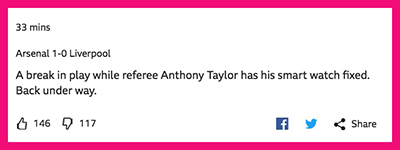
Within a few seconds of the post being published, the ‘thumbs up’ and ‘thumbs down’ reactions began to appear. But what exactly were these people casting their opinion on? The message seemed sufficiently innocuous that it was difficult to see how anyone could take a side. Were the ‘thumbs up’ for the simple fact that Anthony Taylor had got his ‘smart watch fixed’? Or because the match was ‘back under way’? If so, what were the ‘thumbs down’ voting for? Because they didn’t want Anthony Taylor to get his smart watch fixed? Or because they were displeased that the match was back under way?
It was puzzling.
Perhaps some people are just positive by nature, and press ‘thumbs up’ whatever the content of the message and, similarly, others naturally pessimistic and will always press ‘thumbs down’?
Or, perhaps, it is just the response of the voiceless? The curse of social media: people wanting to be noticed no matter how banal the contribution.
© Donnie Blake

Donnie Blake gives a thumbs up to sitting quietly and watching the BBC live text updates without interacting.
Donnie Blake is the author of the World Cup Detective series of football fiction novels.
 Mudskipper Press