
I say a daytrip, but that requires some qualification. A daytrip has to start and end somewhere. You would be hard-pushed to make this a daytrip from New York, for example. Or from London. Or even from Munich. And believe me, I did look into it. My daytrip starts and ends in Salzburg, which might seem somewhat surprising given that the Eagle’s Nest (or the Kehlsteinhaus) lies in Germany and Salzburg is in Austria but, as far as major stopping-off points are concerned, Salzburg is closer to the Kehlsteinhaus than any other city.
I take an organised tour. Once again, I had looked into alternatives, but gave them all up as hopelessly impractical without my own transport. So, I find myself on an early morning Panoramatours’ coach, setting off from Mirabell Square, in the company of fifty strangers, journeying the relatively modest distance of twenty-five kilometres south to our first rendezvous point, the slightly ominously named Documentation Centre.
Despite its intimidatingly officious name, the Documentation Centre proves to be little more than a big carpark. But it is here that a change of transport is required. The Salzburg coach is abandoned; a new bus and new driver, one experienced on the winding, mountain roads, which lead up the Kehlstein, takes command.
The scenery of the Berchtesgaden Alps is stunning. The higher the bus climbs, increasingly more expansive the view. Until eventually… another carpark.
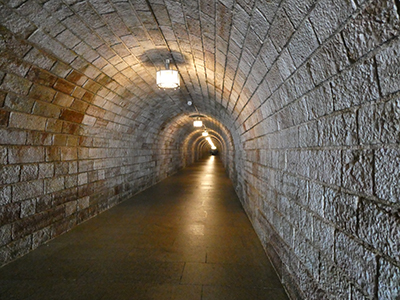
Here, though, there is a mysterious brick-vaulted tunnel leading into the mountainside. It is wide enough to take a Mercedes ‘Grosser’ but, instead, we walk. At the end of the tunnel is a lift. For such a rural location, it is a surprisingly ornate lift, decorated in gleaming brass and brightly reflecting mirrors. And, at the summit of the lift? Well, nowadays, a rather boring café.

It is a long way to come for such an anti-climax. Of course, the reality is that few people travel all the way to the Kehlsteinhaus simply to sample the current plat du jour. The tunnel, lift and mountain-top building were all originally designed by Martin Bormann to provide a meeting-place for senior Nazi Party members during World War Two. It was a favourite location for Adolf Hitler. And it is not hard to see why. The location of the Kehlsteinhaus is spectacular. It is easy to see why it is known as the Eagle’s Nest. There are panoramic views in all directions of the surrounding mountains, and of the town of Berchtesgaden to the northwest. Very little sign of the building’s inglorious history still exists.

At the time of my visit––early on in the season in May; the roads being impassable for much of the winter––there was still deep snow laying on the mountainside, making any ventures off the designated path a foolish endeavour. The sun is shining bright and, despite the altitude, it is not cold. The Kehlsteinhaus becomes secondary to the majesty of its surroundings. It is a day to be outside in optimistic nature; not tracing the history of a dark past.

However, my organised tour is operating to a tight schedule, and there is only so much time permitted to stand and stare. Soon, the bus is backtracking down the mountainside, for a lunch stop at the picturesque town of Berchtesgaden.
Overshadowed, in many ways, by its close proximity to the Eagle’s Nest, Berchtesgaden is a pleasant place to while away a few hours. Unlike my fellow travellers, most of whom descend upon the comfy chairs and hearty dishes of the nearest restaurant, I grab a sandwich that I can eat on the hoof, and attempt to walk as many of the streets of the small, alpine town as I can manage before my coach’s allotted departure time.

Once past the initial glitzy barrage of souvenir shops selling various items of lederhosen and local delicacies, I soon find myself in Schlossplatz facing the impressive frontages of Stiftskirche St Peter und Johannes der Täufer, the Königliches Schloss Berchtesgaden, and the cloisters with their murals depicting Berchtesgaden’s history.

I am torn between stopping to investigate each building or exploring further afield; all the time, I am conscious of the ticking clock of organised tourism; can almost hear the driver of the Panoramatours’ coach beginning to rev his engine, anxious to be back in Salzburg ahead of schedule.
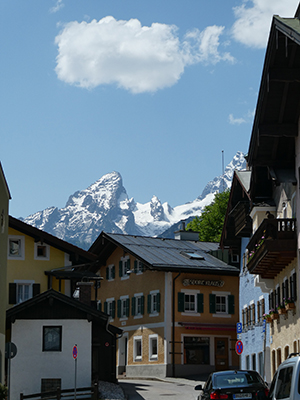
In the end, it is the beauty of the mountains, which calms me; halts me. On all sides, it is the snowy peaks, which dominate the view. It is their natural history, which should be celebrated in this beautiful corner of Germany. I find a quiet bench, take out my sandwich, and end up simply sitting and enjoying the view.
© E. C. Glendenny

E. C. Glendenny is fashionably late for her coach.
 Mudskipper Press