
Not everyone’s idea of a romantic date, perhaps: a visit to a sewage treatment works. But, Crossness Pumping Station is not just any sewage treatment works.
Built in the mid-19th century and designed by Sir Joseph Bazalgette, it was rightly described by art historian Nikolaus Pevsner as a ‘masterpiece of engineering’.
Still not sold? Well, Pevsner also described it as a ‘cathedral of ironwork’, and it was this ironwork, which I was particularly keen to visit, having previously seen photographs of the beautiful decorative designs and colourful décor.

To get to Crossness required a tube journey to Abbey Wood, followed by a 30-minute walk through A Clockwork Orange’s Flat Block Marina territory, across the Thamesmead Estate. Rather than the haunt of Droogs, however, the most dangerous inhabitants I encountered were a small gaggle of geese, defending their young.
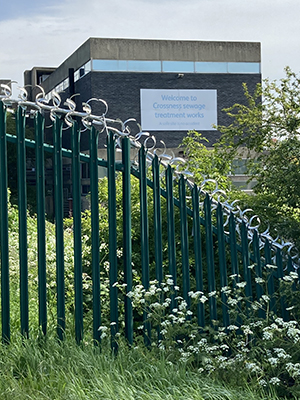
Crossness, itself, is only open to the public on limited occasions, but I had pre-booked a 3-hour guided tour and, reassuringly, found myself met in front of an imposing barrier of razor-wire by a kindly-faced elderly gentleman, who pointed me in the direction of a rising footpath, at the end of which he assured me that a train would be waiting for me. And, unlikely though it seemed, so it was. A small engine, running on a single-gauge track, staffed by friendly volunteers, who invited me to step up onto the footplate and sound the train’s horn. I mean, who could resist?

A brief journey of a couple of minutes––I opted to sit in an alfresco carriage, rather than first class, since it was a sunny day––brought me to the old pumping station itself, where I joined a miscellaneous––predominately rather elderly––group of fellow enthusiasts, some having journeyed from as far afield as Arizona for the experience. Now, that is dedication to sewerage.

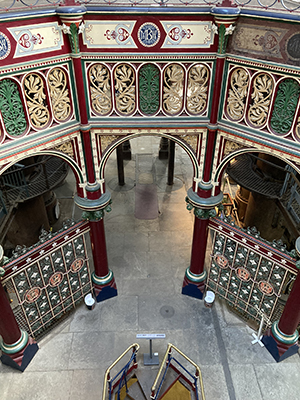
The tour started with an interesting presentation of slides about pre-sanitised London––cholera; a polluted Thames; the Great Stink––you get the idea. Then we moved on to a tour of the actual buildings––now all Grade 1 listed––including the Valve House; the Fitting Shop… it was all very educational, but I was champing at the bit to get to the ‘cathedral of ironwork’: the Octagon, in the Beam Engine House. Where I could see that many of my fellow visitor’s interests were centred around the history or the engineering of Crossness, for me it was all about the aesthetics.

But, I was not to be disappointed.
Amidst all the facts and figures about the number of oiling points it took to lubricate the pumping engines, and the number of people who had died of cholera in Broad Street, Soho in 1854 before Dr John Snow identified the polluting stand pump, which was the cause of all the trouble, there was a place for me, too.
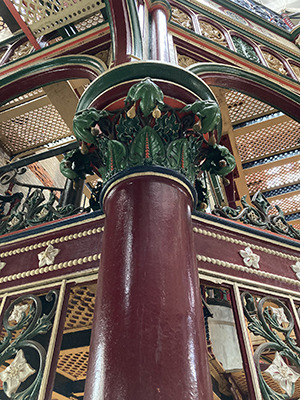
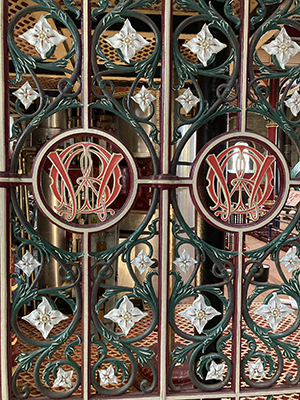
The Octagon was a riot of colourful cast iron: delicate, intricate designs based on natural themes, in stark contrast to the heavy, industrial machinery of the main plant. Unnecessarily decorative; excessively ornate; revealing an unexpected human heart beating within the stereotype of Victorian industrial grind and efficiency. There was humour, too. Depicted on the capitals at the top of the pillars were details of figs and senna plants––famous laxatives––whilst amidst the panels were blackberries, brambles and dogwood––natural costives. Even in art, reminders of the true purport of this establishment are never far away.
And, when the wind is blowing in a certain direction, a reminder of the ongoing purpose of the place is still only too apparent, too. Amidst everything else I learned––Thomas Crapper did not invent the flushing toilet, and the word ‘crap’ did not have anything to do with his surname; its etymology is of Middle English origin––one fact which particularly resonated with me was that as recently as 1998, so-called Bovril Boats, loaded with human effluent, were routinely sailed out along the Thames, in order to dump their unsavoury cargo in the sea close to Clacton.
It made me thankful that my childhood seaside holidays were spent chiefly in Kent and not in Essex.
© Bradley Dunbar

Bradley Dunbar has spent too long gazing into the Black Deep.
 Mudskipper Press