
Few things bring a frisson of danger to a walk more than the possibility that you may not be able to retrace your steps. Walking to Coney Island in County Sligo, there is an ever-real danger that your steps may be obliterated by a rising tide.
I suppose the possible peril is implicit in the name: Coney Island. There are few islands where it is possible to walk to them. Sail, swim, snorkel: yes. Walk: no.
Coney Island is an exception. When the tides are favourable, it is possible to follow a route marked by 14 stone markers across 2.5kms of the Cummeen Strand from the Coolera Peninsula to set foot on the island without getting wet. When the tides are not favourable, the Atlantic is swift enough to fill up Sligo Bay and make the island inaccessible; no longer even reachable by boat, now that the regular service from Rosses Point has stopped.
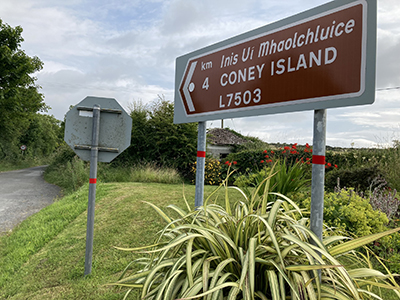
I take an S2 bus from Sligo to the GAA Centre, where a signpost on the opposite side of the road indicates the path to take towards Coney. At this point, the island is not in sight, but it is not long before the shore is reached, and the sand ahead appears as a patchwork of retreating pools and golden terra firma.
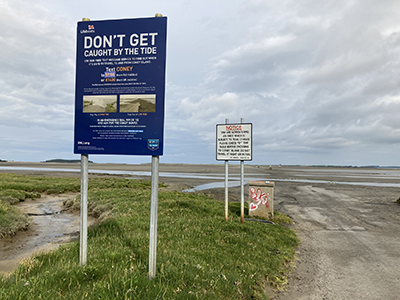
A large sign warns of the dangers of crossing; suggests a phone number to text to check tide times––unanswered. A large, bearded man emerges from a tent on the sand’s edge, his powerful motorbike parked alongside. The first of the fourteen stone markers is an obvious landmark directly ahead. I take my first steps onto the sand.
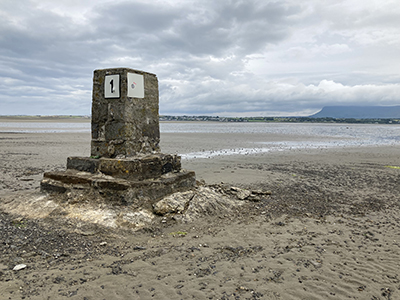
The sand is surprisingly firm; firmer than I had expected from sand that is routinely submerged twice a day. The bay ahead is flat and wide; contained by the summits of distant Benbulbin to the right and Knocknarea to the left. Coney Island, itself, appears a long way distant, low-lying and deserted.
I start counting off stone bollards: two; three; four; five; six; seven. Halfway across and I see a car speeding across the sands behind me; overtakes; a brief wave to fellow travellers.

There are already tyre marks in the sand of an early-riser doing doughnuts––I suspect beardie in his tent. The wind picks up, and the sand begins to eddy at my feet, creating delicate dancing patterns to the distance.
I know that I have allowed plenty of time for my crossing––and return––but it still feels like a race against the clock. The car travellers are already returning; another wave.
Eight; nine; ten; eleven; twelve; thirteen. The final bollard is in sight, and beyond Coney Island itself, so named because of the rabbits, which inhabit it.

I step ashore, the sand ending in a low, grassy hummock. I see no rabbits, just the white, bleached husks of several small crabs. At one time, the island had a population of over one hundred people; now it is only inhabited if beardie decides to pitch his tent there.
The wind is suddenly stronger, and I know that beyond the short stretch of grass, the waves of the Atlantic are massing, waiting to block off my retreat. My mission is accomplished simply by getting here; I do not need to explore further.

I turn my back on Coney Island and start counting again. Fourteen, thirteen, twelve…
© E. C. Glendenny

E. C. Glendenny keeps a close watch on the tide.
 Mudskipper Press