
He was quite a scary fellow, my guide at Kilmainham Gaol. Shouty. Loud and impassioned, but with good reason. He was recounting a passionate history. Rather like on a different year’s visit to Heligoland, it did not seem the moment to stick my head above the parapet and say “I’m English” when he asked our group where we all came from. I stuck with the Spanish contingent, kept my mouth shut, and tried to look invisible.

Similarly, I was still playing the role of a shrinking violet when he followed up his first question with a second one:
“Who can tell me the difference between a prison and a jail?”
It was too much like my secondary school classroom when I didn’t know the answer to the teacher’s question: avert eyes; hope against hope that your name isn’t called to provide an answer.
Thankfully, the Kilmainham Gaol guide provides the answer to his own question:
“Jails are for temporary holding, often while someone is awaiting trial, while prisons are long-term confinement facilities.” (Which still begs the question, what is the difference between a ‘jail’ and a ‘gaol’? Ed.)

It had been a rush to get to the tour. I had started the day in Derry. 150 miles away. Train to Lanyon Place, Belfast. Replacement bus from there to Newry. Train from there to Dublin’s Connolly Station. Tram to Smithfield. A quick check in at my hotel, and then a taxi to catch the last tour of the day at Kilmainham Gaol Museum.

I knew of Kilmainham’s reputation; knew that it had housed many of the leaders of Ireland’s 1916 Easter Rising against the British; knew that many of these same men had been executed there. A simple cross in an outside courtyard marks the spot where many lives were ended.
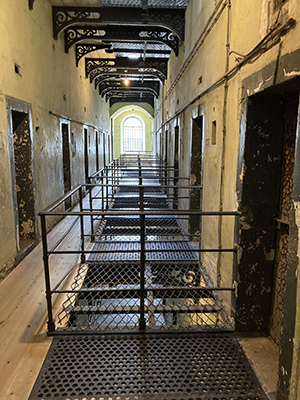
Famous inmates had included Patrick Pearse; James Connolly, Constance Markievicz; Éamon de Valera; Joseph Plunkett; Noël Coward. Noël Coward?
Shame to admit it, but my epiphany moment of the tour came when I suddenly realised that why the panoptic design of the east wing of the Gaol looked so familiar to me was because it had provided one of the filming locations for the 1969 movie The Italian Job. It was where Noël Coward was incarcerated playing the character of Mr. Bridger. Younger movie goers than me are more likely to associate the same location with Paddington 2.
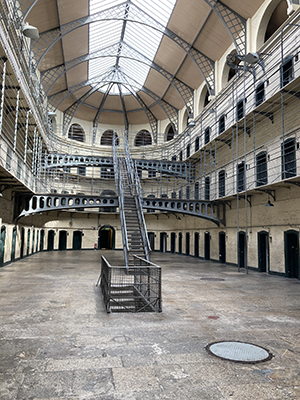

It is in this same spacious courtyard that I observe through a spyhole in one of the cell doors a mural of the Virgin and Child painted on the far wall of the cell. The Madonna of Kilmainham was painted by Grace Gifford, while she was imprisoned in the Gaol in 1923. She was released after a few months, before returning to marry Joseph Plunkett in the chapel at Kilmainham only a few hours before he was executed.

The simple image was a sobering reminder of the strong feelings that Kilmainham continues to inspire, not just in my tour guide, but in all the visitors like myself who joined his excellent tour.
© E. C. Glendenny

E. C. Glendenny enjoys the freedom of Dublin.
 Mudskipper Press