In an age of travel and tourism, it is popular to link the literary history of a writer with a particular place, and more so when the place happens to be rather picturesque. I would bet that more literary pilgrimages are made to Hardy’s Dorset or Brontë’s Haworth than are ever undertaken to Larkin’s Hull. Dylan Thomas’s Laugharne would certainly fall into the picturesque category, although its relative remoteness makes it a less-frequented place of pilgrimage.
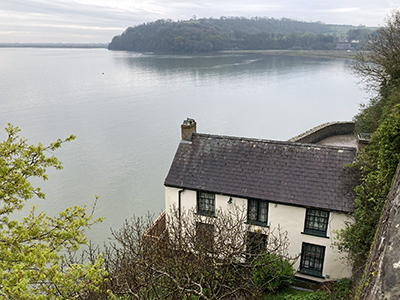
It is to the famous Boathouse that most modern-day literary pilgrims wend their tracks, although Thomas also lived in several other properties in Laugharne, including Sea View in Market Lane, the Cross House Inn at the Grist, a cottage on Gosport Street, and in Castle House, Market Street.
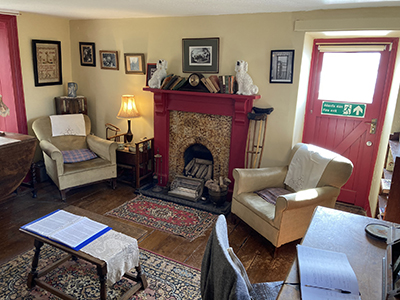
Laugharne provided the inspiration for the village of Llareggub in Under Milk Wood; is the location of his Writing Shed, looking out over the Taf Estuary; and is where he is buried, in the churchyard of St Martin’s Church.


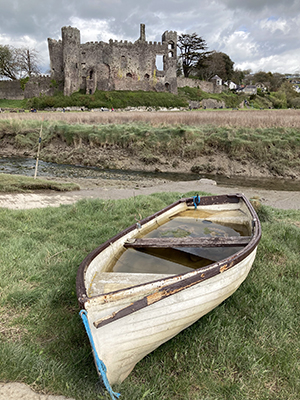
Laugharne, itself, is a beautiful location. It is not really near anything, which is much of its appeal. The fluctuating tides of the Taf Estuary create an ever-shifting landscape of water and wide, exposed mudflats, against which the ruins of a striking, medieval castle stand tall and stark.
I arrive early for my visit to the Boathouse, expecting to have to join a queue and to be fighting off other fellow-travellers, only to find myself the sole visitor. I am able to survey the exhibits in peaceful leisure; watch the documentary film about the life of Dylan Thomas in glorious solitude.
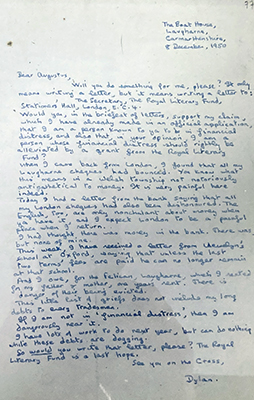
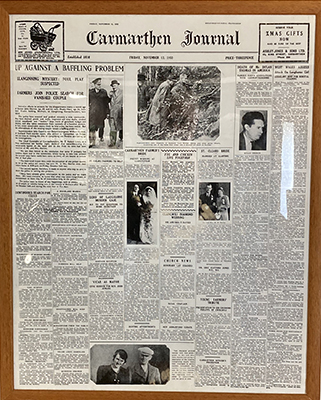
Two things strike me among the items on display: Dylan Thomas’s rather unpoetic, school-boyish handwriting, in a letter he penned to Augustus John; and how, comparatively, unmoved the local Carmarthenshire press were by the news of his death. A page from the Carmarthen Journal records his death in New York in November 1953, but their headline story is the search for a missing local couple.
Dylan Thomas’s grave is a similarly understated affair. A simple, white wooden cross in a field outside the main graveyard at St Martin’s Church. It shows little sign of being visited any more frequently than any of the other graves surrounding it. Now, don’t get me wrong, I like this exclusivity; it just seems strange for someone widely regarded as Wales’s greatest poet.

I return to the café at the Boathouse; sit at a table outside with a wonderful view of the wild estuary, watching two shelducks wading across the mud, and eat one of their excellent, homemade Welsh cakes. What do I care that I am a solitary pilgrim? Bugger all.
© Fergus Longfellow

Rather shamefully, Fergus Longfellow must admit to not having read Under Milk Wood, or Portrait of the Artist as a Young Dog, or Adventures in the Skin Trade. He could go on…
 Mudskipper Press