
The British Atlantis. The thing that Dunwich is most famous for is that it is no longer there. Once the most important Anglo Saxon port on the East Coast, the combined effects of a series of fierce storms in the 13th and 14th centuries and the long process of coastal erosion have resulted in most of the old town being lost beneath the North Sea.
Today, Dunwich consists of a small hamlet of dwellings, a large pub, a small museum, a beachside café, St James’ Church, and the clifftop remains of Greyfriars Monastery. In its heyday, the town had a population of several thousand, multiple churches and monasteries, not to mention a thriving port, enclosed by a natural harbour. Nowadays, the beach is a long line of unbroken shingle.
There are many romantic superstitions linked with Dunwich. At certain tides, it is said it is possible to hear the peal of submerged church bells. For myself, I only heard the cries of black-headed gulls.

The Dunwich Museum is a good place to discover the story of Dunwich’s past. Despite its modest size, the museum contains a comprehensive history of Dunwich from ancient times to the modern day. I spent an informative hour scrutinising its exhibits and mentally attempting to assimilate a map of old Dunwich, before returning to the beach to gaze out upon the site of where the old town was deluged.
There, to the left, beneath the featureless, flat grey sea, would have been the Chapel of St Francis. Straight ahead, the Guildhall. Off to the right, the old preceptory of the Knights Templars. All gone.
I want to feel something of their presence; those old buildings; the noisy, bustling street; all the former residents who once called Dunwich home. I want to reach out across the centuries and join hands with this lost civilisation, but the sea is too great a leveller. There is nothing left. No inkling of the previous era’s rich glories. Just sea and shingle.
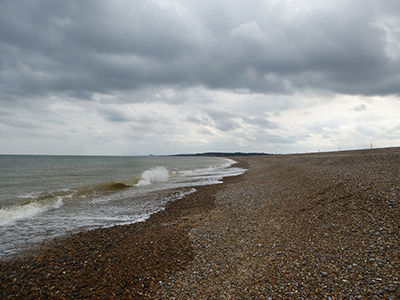
A wind begins to whip up from the east and the waves begin to break with a greater ferocity of white foam and constant noise. One last look for a sign of Britain’s Atlantis, but it is too elusive for my brief scrutiny, and all I am left with is an abiding image of white-domed Sizewell B nuclear power station, ever-present on the distant horizon.
© E. C. Glendenny

E. C. Glendenny scans the horizon for signs of Dunwich.
 Mudskipper Press
[…] tale of Dunwich’s disappearance beneath the sea is well documented; documented by me, amidst many other more […]
LikeLike