
The tale of Dunwich’s disappearance beneath the sea is well documented; documented by me, amidst many other more worthies.
The most recent of Dunwich’s churches to be lost to the waves is All Saints’: a Norman church; restored during the reign of Henry VIII; last used for services during the mid 1750s; to be consumed by the sea in the early part of the 20th century. However, a few tantalising relics of All Saints’ still remain.
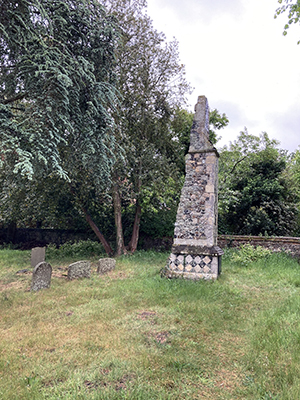
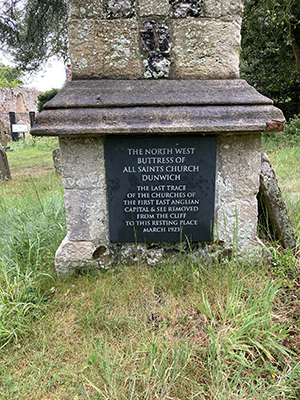
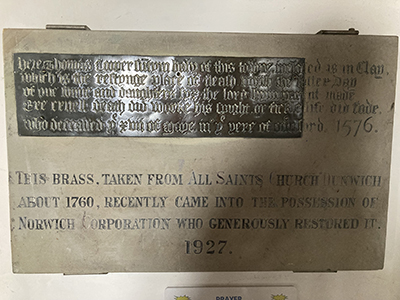
Most significant is the northwest buttress of the old church tower, which now stands in the graveyard of St James’ Church, to the north of the village. Inside St James’ Church there is also a brass plaque from All Saints’, which was rescued/filched in the 1760s.
South of the village, close to the site of the ruins of Greyfriars Monastery, there is the last gravestone from All Saints’ Church. It is located 40m, or so, from where it would have been originally located, and the inscription on the stone reads:
“In Memory of JACOB FORSTER who departed this Life March 12th 1796 Aged 38 Years.”

A sign nearby warns that: “The cliff is very close, high and dangerous at this point.”
The Dunwich Museum contains many photographs of All Saints’ Church from the early years of the 20th century; picturesque in its ruin; its inevitable and imminent mortality already all too obvious. Expressive images, as poignant as any sermon, which may once have been heard within its walls.
© E. C. Glendenny

E. C. Glendenny, respect for All Saints’.
 Mudskipper Press