
It is almost 40 years since I last stood on the top of the Eiffel Tower in Paris. The queues and crowds have deterred me from returning ever since.
But, I did ascend to the top of another tower that Gustave Eiffel helped to build much more recently. That is the Sainte-Cécile Observatory in Arcachon.

Like its more famous cousin, it is a metal construction, and it was completed in 1863, 26 years before the tower in Paris.
However, it is a bit shorter. Standing a proud 25 metres high, it is 305 metres shorter to be precise. That fact notwithstanding, I would assert that the ascent of the Sainte-Cécile Observatory is the more scary of the two.
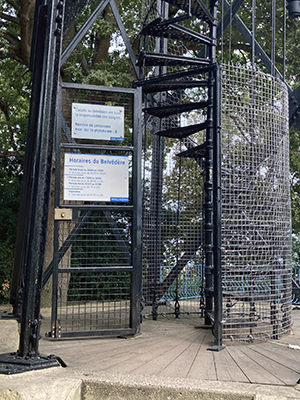
A notice at the bottom of the structure warns that the belvedere at the summit of the tower can only hold eight people at a time. It is a testament to the structure’s fragile appearance that this warning was strictly adhered to by the queue of wannabe ascenders, at least during the time of my visit.
The viewing platform is reached by means of a narrow, metal, spiral staircase, which corkscrews through the centre of the construction; a narrow, metal, spiral staircase, which wobbles alarmingly at each footfall placed upon it.
I love going up high places, but this one came with a health warning.
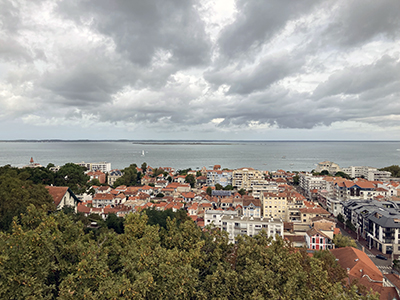
At the summit, the circular belvedere was something of an oasis of calm, with lovely views over the Arcachon Bay and the Île aux Oiseaux in one direction, and the trees and rooftops of the grand villas of the Ville d’Hiver in the other.

I was aware, though, that my time to admire the view was limited. It was not until I descended that one of those waiting below would be permitted to take my place. Conscious of many eyes upon me, I began my dizzy descent, determined to appear the picture of stiff-upper-lip nonchalance when I reached the bottom.
© E. C. Glendenny
E. C. Glendenny feels safe back on terra firma after climbing the Sainte-Cécile Observatory.
 Mudskipper Press