
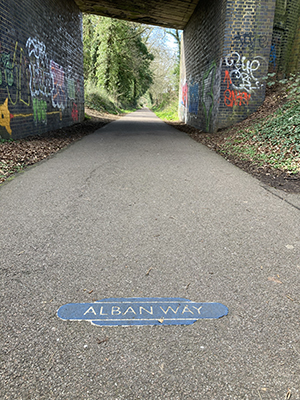
There is one big advantage of footpaths, which run along disused rail lines: they are easy to follow. The Alban Way is no exception. I followed its route for 6.5 miles from St. Albans to Hatfield, along an easy, flat path, signs of the abandoned railway accompanying me from start to finish.
Originally opened in 1865, the Hatfield and St. Albans branch line was closed to passengers in 1951; closing altogether in 1969. Evidence of its original stations and halts are still visible to a greater or lesser degree.
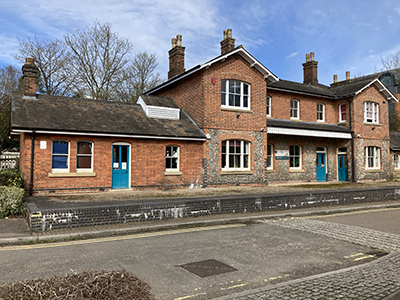
London Road
Walking in the direction from St. Albans to Hatfield, the London Road station is the first landmark on the route. It is the best-preserved station on the Alban Way, with much of the original Grade II listed station building restored and the platform remaining, although today the building is used as a children’s nursery. Just beyond the station, the path passes beneath the impressive Midland Railway Arch.
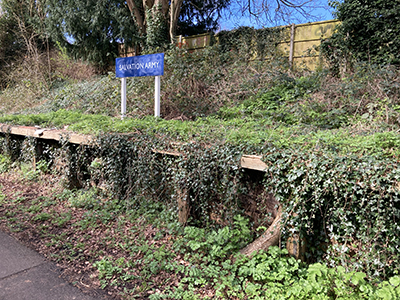
Salvation Army Halt
The first of several now similar-looking, grass-overgrown halts along the route, this platform would have once served the neighbouring Salvation Army printing works and would have been the distribution hub for copies of War Cry around the country.
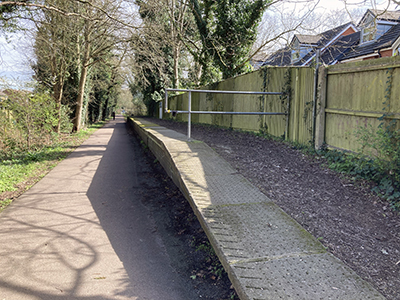
Hill End
The original Hill End station buildings have long since been dismantled, but a recognisable platform still remains, unexceptional at the time of my visit except for the slightly uncanny presence of one lone black woollen glove, which looked remarkably similar to one I had lost on a different railway line only a few days beforehand. The purpose of the original station was to facilitate both the construction, and later the running, of the nearby Hill End Asylum.
Smallford
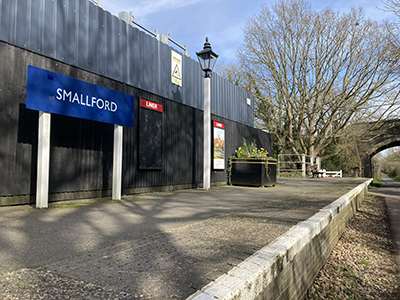
Smallford provides an approximate halfway point on my walk, and is a good place to make a ten-minute detour across country to reach the excellent The Plough pub at Sleapshyde for a pint and a snack. Back at Smallford, both the station building and the station master’s house remain, although they were heavily fenced off at the time of my visit for restoration work. However, the platform showed what can be achieved with a bit of TLC, with the simple addition of an old-fashioned street-light, a tub of bright flowers, and a wooden bench, upon which one fellow traveller had taken residence, looking for all the world like he was simply waiting for the next train’s arrival.
Nast Hyde Halt
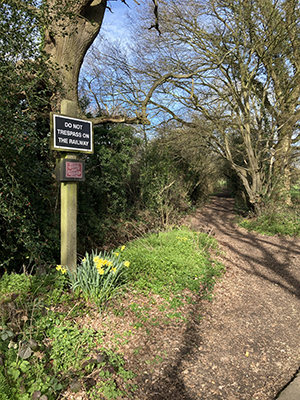
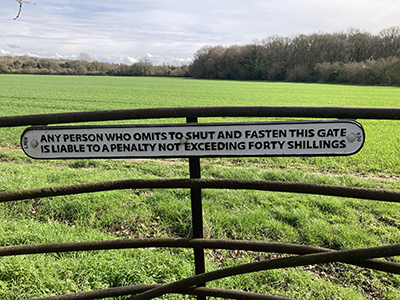
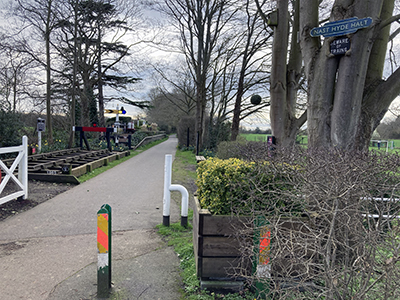
Of all the stopping-off points along the Abbey Way, Nast Hyde Halt has perhaps received the most dedicated attention from enthusiasts of the line. Approaching the halt, numerous signs – both old and new; humorous and, in one case, rather tragic – bedeck wayside trees, warning of ghost trains; of punishments that will be meted out for those who are foolish enough to attempt to cross the tracks; and a plaque recording the death of a young woman, Ethel Violet Mason, struck by a passing train in 1929. The platform itself has been embellished with period features, like traditional milk churns and old advertising slogans, and there was even a bit of visible railway track and a level crossing signal.
Lemsford Road Halt
There is always a point on every walk along an abandoned railway line when you suddenly get the sensation of potential danger. No possible threat from passing trains; more a sudden realisation that you are the only walker, and have been for some time, and that this is actually a rather lonely spot, and that no one is likely to find you if you were suddenly attacked and dragged off into the bushes. That was my feeling at Lemsford Road Halt. My fears were totally unfounded, but the route here is a little less travelled; the path slightly less well maintained. The difference is that the town is beginning to encroach upon the route more than the countryside. Ahead, I can spy the top of the Galleria Shopping Centre.
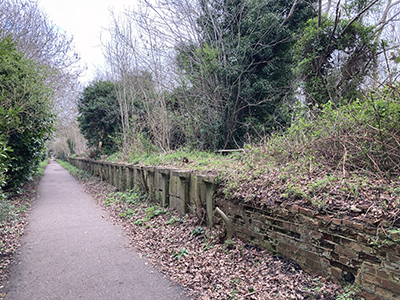
It is the end of the line.
© Simon Turner-Tree
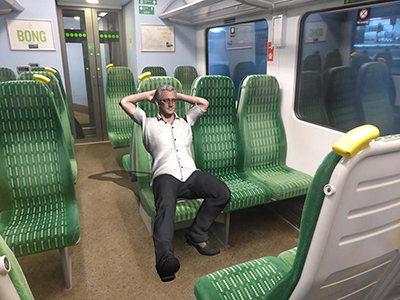
After his walk, Simon Turner-Tree is pleased to rest his feet and get back on the train.
 Mudskipper Press