
There were men in the streets carrying guns. Some of them approached me, slightly menacingly. One barked a command. I couldn’t understand a word he said, but I got the message that I was in the way. I might have been more alarmed if they hadn’t all been dressed in 18th century clothes. Still, it was a lesson: never get between an Italian man and his historical re-enactment.

In fact, my timing couldn’t have been better. Pure luck; no credit due. I had booked to visit the Pietro Micca Museum in Turin and it just so happened that I had arrived on Pietro Micca Day.
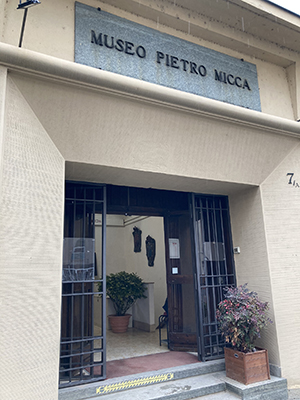
I’ll confess it now: I had absolutely no idea who Pietro Micca was when I booked the visit to the museum named after him. All I knew, was that it was a place where it was possible to explore tunnels, which run beneath Turin, and I am a sucker for any underground tunnels. Booking in advance was a wise move, though: it is no good just turning up at the museum on the off-chance; admittance to the tunnels is by guided tour only.
And, just as well. They were not the kind of tunnels I would have wanted to be lost in. They were first constructed during the War of the Spanish Succession, during the first years of the 18th century. They were designed to protect Turin from the attacking French army, which besieged the city in 1706. Pietro Micca was a hero of the siege, who sacrificed himself to prevent the French from invading the tunnel network.
The tunnels run for fourteen kilometres, much of which is still accessible, although not all open to the public.

I was the only English speaker on my tour––or perhaps more accurately, the only non-Italian speaker––and this afforded me the privilege of a private tour on my own. Being alone, except for my guide, greatly added to the atmosphere of the underground environment, rather than be one in a large, noisy group. There was a silence, other than our footsteps; darkness, other than the guide’s torch.
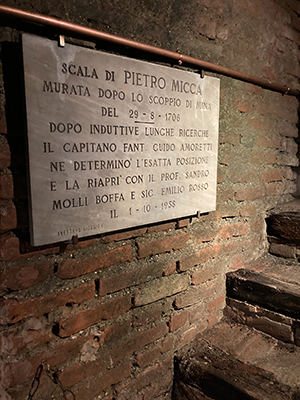
We stopped at several points within the tunnels, saw a commemorative plaque to Pietro Micca, and the place where he had actually died. The idea that hand-to-hand battles had once been fought in such a confined and unforgiving place seemed scarcely imaginable; a terrifying prospect. Face-to-face with the guns of the re-enactment had been scary enough in the daylight of the street; the possibility of ambush in this gloomy, subterranean world would have been endlessly nerve-shredding.
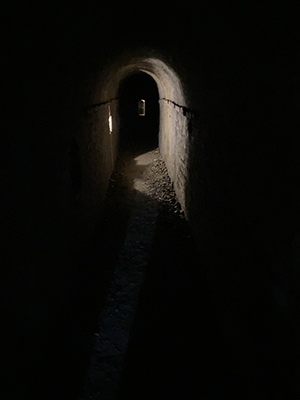
As with all underground tours, I always find myself wondering about the side-tunnels I spot, which I am not allowed to follow. Where do they go? What is at the end of them? I think that my guide senses my nascent off-piste spirit and, sensibly, begins to lead the way back to the steps to the surface.
© E. C. Glendenny

E. C. Glendenny seeks the light at the end of the tunnel.
 Mudskipper Press
[…] out some of E. C. Glendenny’s other adventures underground in the Catacombs of Paris; the subterranean passages beneath Turin; and the tunnels of […]
LikeLike