
Barnaby Rudge is one of Charles Dickens’ lesser-known works, and has been the subject of a good deal of criticism. But, I really don’t know why. It has some terrific and sympathetic characters, and an exciting storyline set against the backdrop of the Gordon Riots of 1780. Personally, I found it a much more entertaining read than Dickens’ other great ‘historical’ novel, A Tale of Two Cities.
By way of something of a Barnaby Rudge pilgrimage, I decided to pay a visit to The Boot pub in Cromer Street, St Pancras, which features at different intervals in the story. I hadn’t been to The Boot for a decade or more. It was little changed in that time. A slightly intimidating ‘locals’ appearance outside, opening up to a friendly, spacious interior.

It was lunchtime; I found myself a door-hanger waiting for the twelve o’clock opening time; ultimately, sat at a corner table with a pint of Guinness, the pub to myself, and reviewed The Boot anew through the lens of Barnaby Rudge.

Ironic, in some ways, that The Boot is now a popular ‘Irish’ pub when, in Barnaby Rudge, it was the headquarters of anti-Papist rabble-rousing
Dickens described The Boot as a place where could be found ‘good company and strong liquor’; ‘a lone house of public entertainment, situated in the fields at the back of the Foundling Hospital; a very solitary spot at that period, and quite deserted after dark’. Now, between the Foundling Museum and The Boot, the only small piece of open ground is Bramber Green; tall housing blocks populating the once empty 18th century fields.
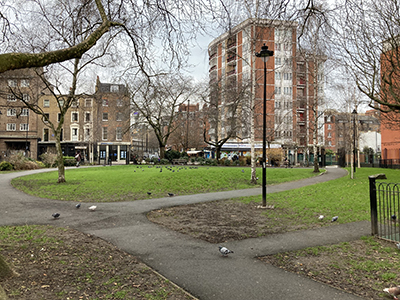
Similarly, the ‘stable and outhouses’ are no more, replaced by a narrow back alley and a row of rubbish bins, but the ‘long, low-roofed chamber’ as depicted by Dickens could still be an appropriate description of the main bar area of The Boot, although it is conspicuous that he made no mention of the pool table, big TV, and walls covered with sporting memorabilia.

If I am being honest, I am not sure my Barnaby Rudge pilgrimage to The Boot was altogether a success. Try as I might over my pint of Guinness, I found it quite hard to pick up any Dickensian vibes. It is almost 250 years since the time of The Boot as described in Barnaby Rudge. The surrounding area of London has changed beyond all recognition. It is a testament to the endurance of pub culture in Britain that The Boot––first founded in 1724––is still standing at all, when so much other history is swept aside without a second look back.
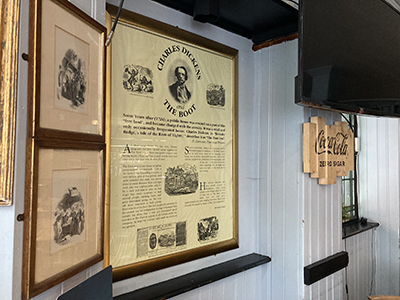
Perhaps the barmaid best expressed that gulf between the centuries. While I waited for my Guinness to be poured, I mentioned my reason for visiting and how I had just finished reading Barnaby Rudge. Clearly not greatly impressed by my literary feat, she replied:
“Is that so? You might like to have a look at that photo on the wall over there. Kenneth Williams. You know, from off the TV. He was another one of our regulars.”
© Fergus Longfellow

Fergus Longfellow enjoys a good Carry On.
Fergus Longfellow is the author of Gently Observed: An Uncritical Reading of the George Gently Crime Novels of Alan Hunter.


[…] remaining novels of Charles Dickens, which I had previously never read. A Tale of Two Cities, Barnaby Rudge, Bleak House and The Pickwick Papers. A quick status report, four months of the year in: […]
LikeLike
[…] spared. Jackie Collins; Jilly Cooper; Harold Robbins. George Eliot; Charlotte Brontë; Charles Dickens. All are mere fodder for Voracious […]
LikeLike