
The Palmyra Palm is the national tree of Cambodia and it is hard to travel anywhere in the country without spotting their distinctive outline. There is something about their geometric shape and spiky, fan-shaped leaves that makes me feel like they are growing upside down; or makes me want to turn my head on one side to view them. I don’t know what it is about them; I can’t explain it. Anablephobia? Can’t be. I don’t feel the same way about other trees.
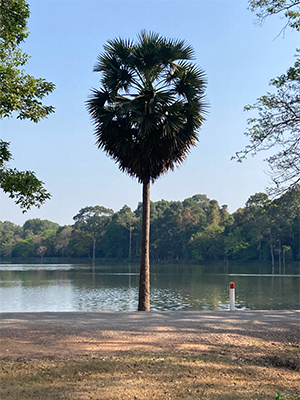
In the countryside, Palmyra Palms appear in small groups lining vibrant green rice fields; they grow on river banks, up and down the country; and vie for attention amidst the towering temple ruins at Angkor Wat.
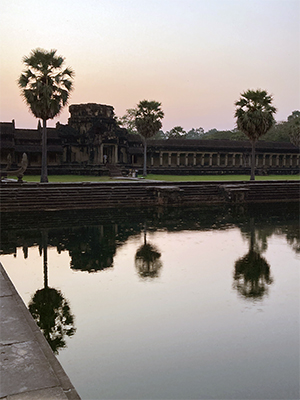
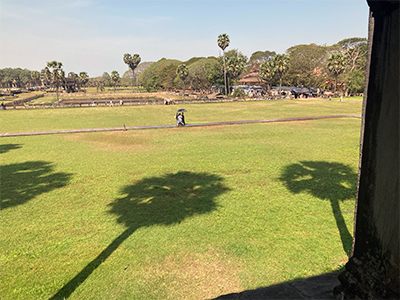
I spent a lot of time trying to take a photograph of a Palmyra Palm, which matched the sense of beauty they inspired in me, largely to no avail. A perfect grouping of trees would appear in the landscape as I was speeding past in a bus, but I was always too late to focus my camera before it was gone and the decisive moment lost. They would appear as a reflection; a silhouette; or a shadow, but there was no way that I could replicate the aesthetic flawlessness of Nature. Did Jean Shrimpton ever make it easy for David Bailey? An icon cannot be pinned down so easily.
For me, the Palmyra Palm is the defining image of my time in Cambodia. It was an ever-present natural wonder, which rivalled in beauty the man-made splendour of the temple complex at Angkor Wat and the Royal Palace and Silver Pagoda in Phnom Penh.
© E. C. Glendenny

E. C. Glendenny shows her appreciation of the Palmyra palm tree.

