
Of all the many temple complexes in Cambodia, the one that most easily bridges the gap between the past and the present is Bayon. It is easy to see why. Everywhere you turn, you are greeted by a smiling face.
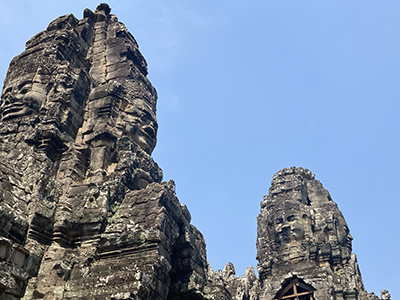
Bayon is located within Angkor Thom and is characterised by a serious of four-sided towers, each side of which is adorned by a carved stone face, supposed to represent either the Bodhisattva Avalokiteśvara or King Jayavarman VII.
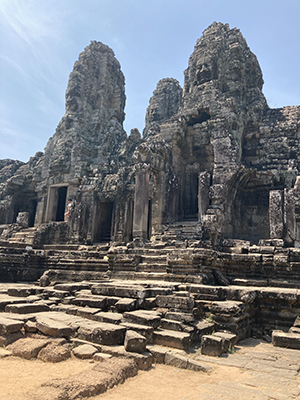
Now, if I had been the architect charged with representing four sides of humanity for time immemorial, I would probably have portrayed four quite conflicting emotions. Happiness, yes, surely, but also sadness; perhaps fear; perhaps anger. On the whole, my towers would have reflected a rather conflicted humanity.
Bayon is different. Bayon only depicts positive human attributes. Compassion (karuna), joy (mudita), equanimity (upekkha), kindness (metta). And, as a result of this upbeat approach to architecture, it is a joyful place. A smile is infectious.
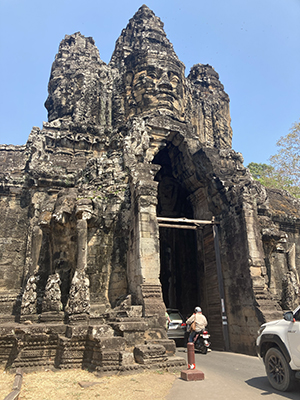
It is unusual to be confronted with an ancient temple, which is quite so in yer face. I have heard people sometimes describe an old portrait where the eyes follow you around the room; at Bayon, the eyes are everywhere. There is nowhere within the temple complex where you can avoid scrutiny; you are always being observed from across the centuries.
This is ancient Big Brother society.
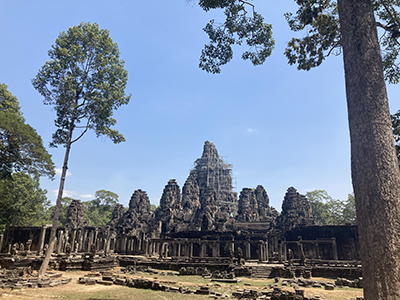
However, here, though, the scrutiny feels benevolent, not Orwellian-oppressive. It is genuinely as though a higher authority is watching over you. And smiling.
Smiling at your triumphs.
But, equally amused, smiling at your myriad mistakes.
© E. C. Glendenny

E. C. Glendenny feels joyful to visit Bayon, Cambodia.


[…] is the smiley faces that make me give Bayon my top-spot. The approach to the temple is over a magnificent bridge lined by statues of […]
LikeLike