I’ve run up and down plenty of sand dunes in my time. Pleasant little affairs. Sandy hummocks, rarely rising much above my own height.
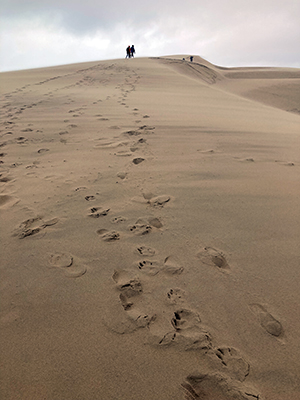
The Dune of Pilat is not like that. It is something different. It is a goliath amongst sand dunes. The largest in Europe, in fact. It is located about 8 kilometres south of Arcachon on the French Atlantic coast, it rises over 100 metres above sea level, and is roughly 2.7 kilometres in length.
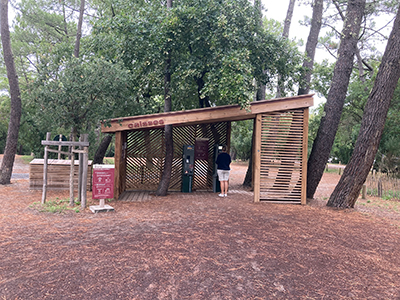
Taking the #3 bus from Arcachon to the Dune of Pilat stop, you are left with a short woodland walk and an eco-friendly visitors’ complex––complete with souvenir shop, café, toilets, and an introductory film about the dune eco-system––before the start of the dune itself. But there is no mistaking the dune. It emerges from the pine forest as a vertical wall of sand, with no obvious summit in sight.
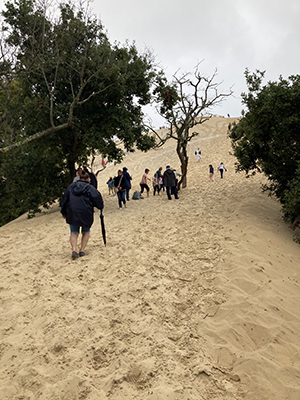
For the less eco-minded, there is a 130-step staircase to reach the top of the dune, but this seems rather pedestrian. I decide to go off piste. Slip of my shoes and socks, and get stuck into the virgin sand.
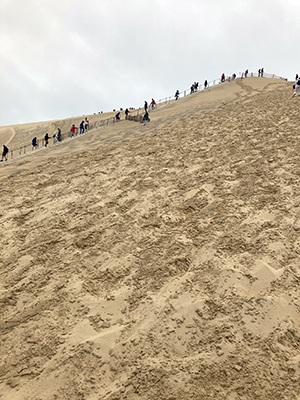
It proves quite tough going. Walking on sand is hard at the best of times; walking on sand on an incline is particularly challenging. The sand is soft and slips back at each footstep. The ascent is quite steep, and for every step forward I feel as though I am making two back. But the view. Very quickly, the view becomes remarkable.
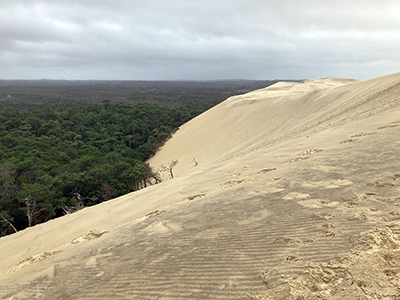
In one direction, there is thick pine forest; in another, the Atlantic Ocean; and ahead, sand. Sand, sand, and nothing but sand.
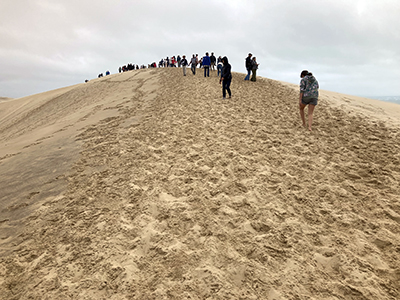
The summit of the staircase is a mustering point for most visitors. Away from this point, though, and people quickly disappear. While many sightseers want to ascend the Dune of Pilat, very few are like me and want to walk the entire length of it. On any other surface, 2.7 kilometres would be a relatively straightforward stroll, but on undulating sand, in a high wind––as it was the day I visited––it is quite an energetic ramble.
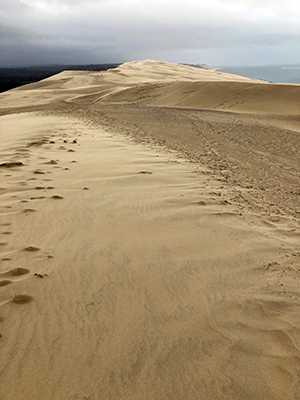
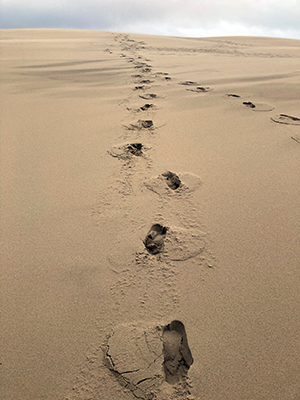
At times, I feel like the last person left on earth. In all directions, there is no one else in sight, only the fast-filling footsteps of the last traveller who traced this route. In a desert, I might feel alarmed to find myself in a similar situation, but I know that this sea of sand has clearly-defined borders––forest; ocean––I cannot stray far from my track without hitting one or the other one. But ahead? I don’t know what to expect. At the moment, there is nothing to see in that direction but more sand.
Offshore, I spy the Banc d’Arguin sandbank and, in the distance, the very tip of Cap Ferret. In the other direction, the pine forest clearly show the blackened signs of the devastating fire, which raged through the region in July 2022. For myself, I feel in an elevated world, separated from both trees and water; almost as if I am on board the deck of a vast ocean-liner, cutting a swathe through both environments.
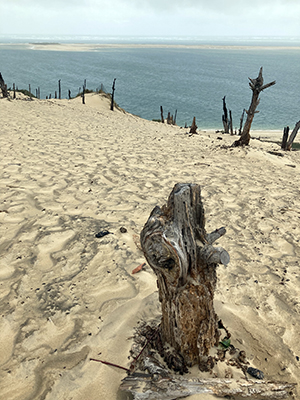
Gradually, though, the landscape changes. Ahead, it is no longer just sand. There are the charred stumps of several trees and, eventually, a campsite; an unlikely outpost of civilisation at the ‘far side’ of the Dune. Praise be, also for a Sunday timetable: there is even a #3 bus waiting, ready to transport me back to Arcachon again having fulfilled my walk.
© E. C. Glendenny
E. C. Glendenny feels the sand beneath her feet on the Dune of Pilat.


[…] was looking forward to a dip in the sea at Arcachon. It was September. The waters in Arcachon Bay had had the whole of the summer to warm […]
LikeLike