
Before I arrived at Angkor Wat, I knew the headline statistic: it is the largest religious structure in the world. What I hadn’t fully appreciated was just how large that meant it is. Angkor Wat is just one temple within the entire Angkor Archaeological Park, and that area covers around 400 square kilometres. That means journey times (by bus or car) between some of the different temple sites can run into fairly lengthy trips. For example, Angkor Wat to Banteay Srei is about 30kms and can take over three quarter of an hour by road.
I was fortunate to spend several days at Angkor and to visit a number of the temples, both large and small, and each had its own special features and atmosphere, from ancient Lolei, the imposing six towers at Preah Ko, to the pin-up Angkor Wat itself.
When each location is so different, it is hard to rank the various sites in any meaningful fashion, and so I have fallen back on a less than academic judgement: personal preference.
BAYON
It is the smiley faces that make me give Bayon my top-spot. The approach to the temple is over a magnificent bridge lined by statues of devas (gods) and asuras (demons), before passing through the vast South Gate into the ancient city of Angkor Thom. The temple of Bayon itself is characterised by multiple four-sided towers topped by carved faces, each smiling down benignly upon their modern-day visitors.

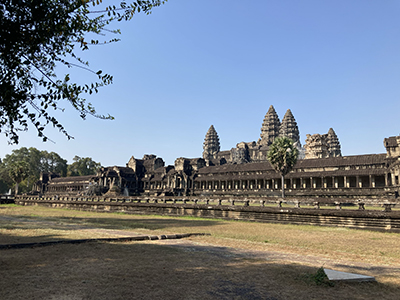
ANGKOR WAT
Angkor Wat is iconic. Vast, breathtaking, and set amidst immense green lawns, with stunning vistas in every direction. An unmissable highlight of any trip to Angkor. The only downside of being an icon is that you are also in demand, and it is hard to escape the mass of fellow visitors to be able to enjoy a quiet, reflective moment to think about the beauty of the surroundings.
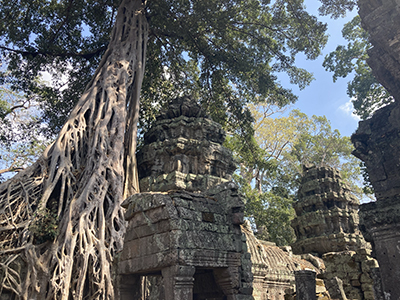
TA PROHM
Known as the Tomb Raider temple, and featuring in the Angelina Jolie film of that name, Ta Prohm is recognisable for the towering and tortuous strangler fig trees that wind around and grow through the ancient stone structures. Here, it is possible to truly picture the temple complex as it must have looked when it was first rediscovered from amidst the surrounding jungle.
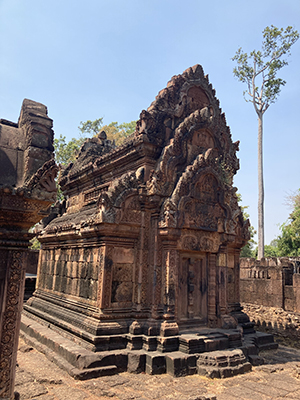
BANTEAY SREI
Banteay Srei is famous for having been constructed from a reddish-pink sandstone, and for the beauty and delicacy of the carvings on its walls. It is one of the most outlying temples in the Archaeological Park, but is well worth the effort of a visit, the site feeling rather more intimate than some of the grander or more sprawling complexes.
BAKONG
A particular attraction at Bakong are the peaceful waters surrounding the temple area, many of the streams and lakes covered in beautiful, flowering water lilies. Bakong feels rather like Angkor Wat but on a smaller scale – and with fewer visitors – and boasts a central tower with a lotus-shaped top, similar in design to the five towers at its more famous neighbour.

It was a privilege to explore the Angkor Archaeological Park, and any visitor will come away with their own special memories and personal favourites from among the numerous sites to visit.
© E. C. Glendenny

E. C. Glendenny heads off to her next temple.

